Glimpses into the film

Snapshot

A growing set of glimpses into JEWISH, a feature musical film in development. More will be added over time. The first is the opening scene.

The Opening

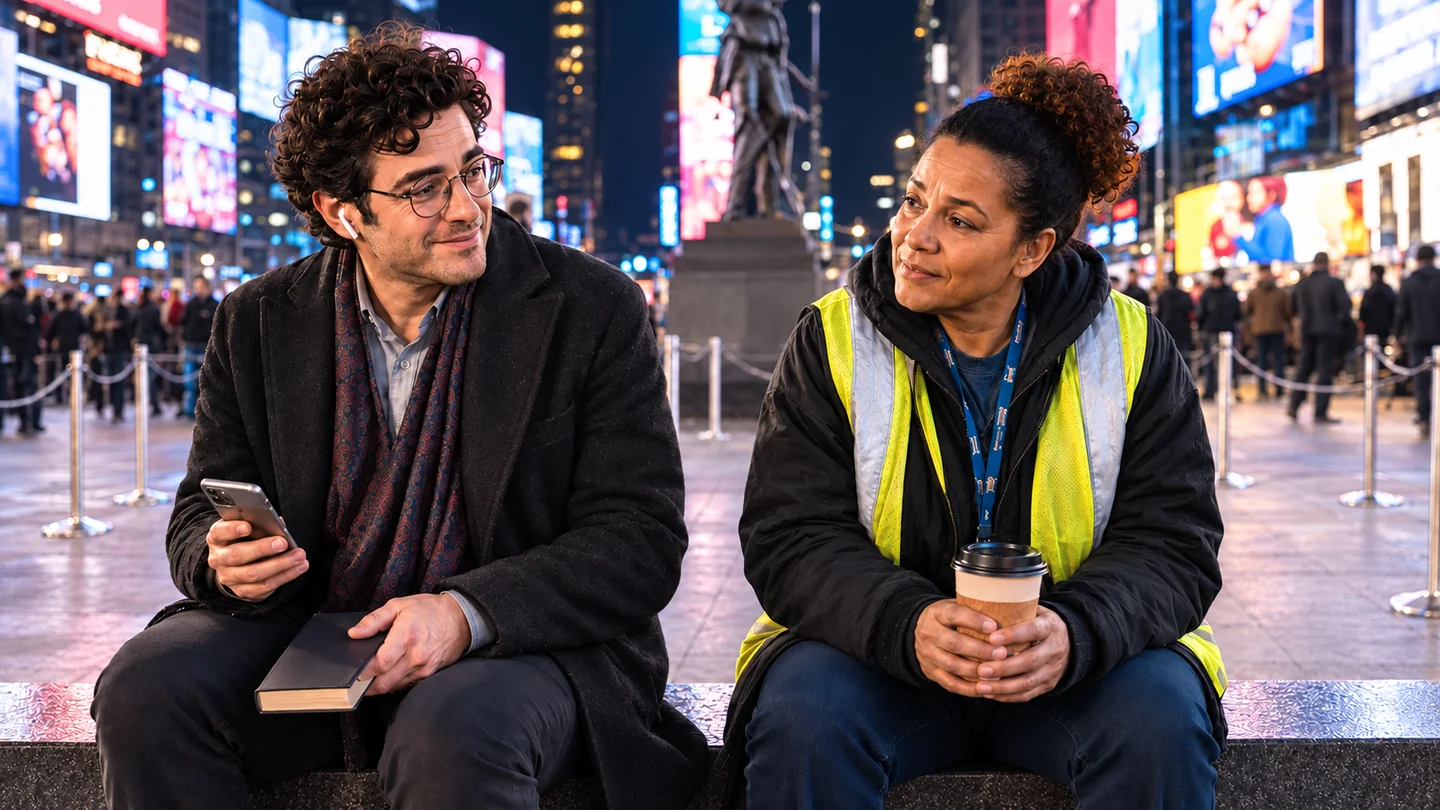
A man in a worn coat sits on a granite ledge above a neon-lit Times Square at night, earbuds in and a cloth-bound songbook on his knee, full and quiet, with strangers seated along the ledge beside him.
Concept illustration. JEWISH is a feature musical film in development.

What his mother sang.

A RIGLI recording, sung by Elechka, Russian words by Olga Anikina.

Late, well after dark, Joseph Shapiro sits at the edge of Times Square, alone, a phone in his hand. He is not looking at the lights. He is not sad. He is full.

When he was a boy his mother used to take him to her concerts, at the senior centers and community halls where the old people went. He loved going. They doted on him, pressed sweets into his hands, called him by his mother's name with a little smile. And his mother always sang. She sat with a guitar across her knee and accompanied herself, and people cried. He never understood, as a boy, how a song could do that to a grown person.

He is ten years old again. He is in a low bright room. His mother is on a little stage with her guitar, and she is singing, and the room has gone still around her.

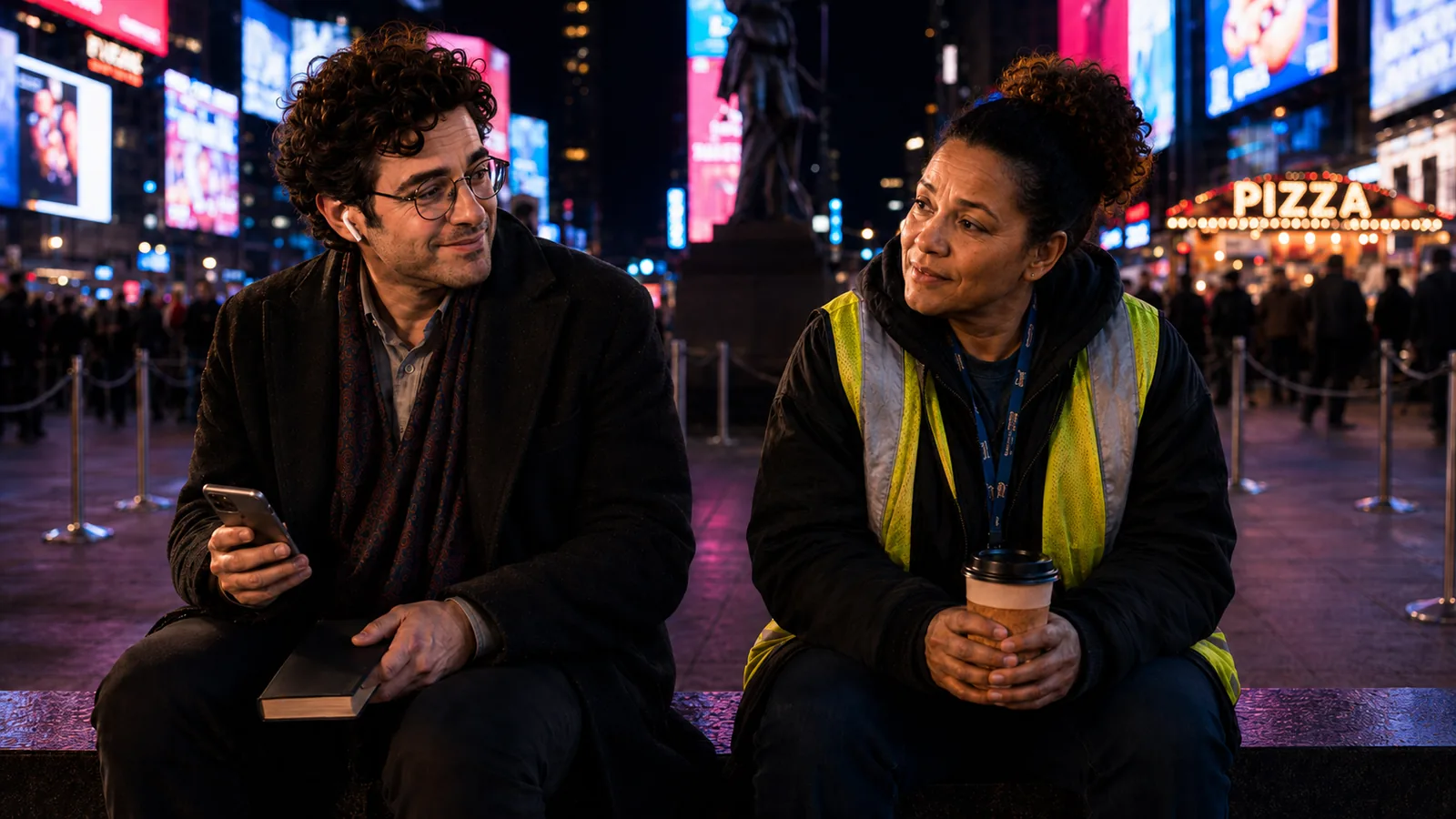
Joseph and the night-shift worker sit together on the granite ledge, turning toward each other, his phone and songbook in his lap and her coffee in her hands, against the neon glow of Times Square.
Concept illustration. JEWISH is a feature musical film in development.

The song that played aloud.

A RIGLI recording, sung by Elechka, Russian words by Olga Anikina.

The memory lets go. Now it is just a recording, another of his mother's, playing in his ears like a soundtrack while he looks around the square. Tumbalalaika this time. He turns to look behind him, and because he is an angular, slightly clumsy man, the turn takes him too far. He goes off the parapet, nearly headfirst, and lands in a heap.

His phone clatters loose, and through its little speaker the song leaps out, loud, into the night. His mother, singing in Russian, over Times Square.

For a moment he cannot get up. Hands reach for him. Are you okay. Easy, easy. He gropes around for his earbuds, embarrassed, certain everyone wants the noise to stop.

They hand him the things that spilled from his pockets. His wallet. His keys. A pen. A handkerchief. But not the phone. He notices, slowly, that no one is handing him the phone.

He looks up. Some of them have stopped. They are listening, the way you listen to something you did not expect, to a woman singing in a language they do not speak. He reaches for the phone to shut it off, and then he does not. He can see they do not want him to. He is not sure, anymore, that he wants to either.

The night-shift worker beside him, after a moment, looks over. "That was beautiful. What language was that?"

"Russian," he says. "Adapted from Yiddish."

She nods slowly, chasing a thought she cannot quite reach. She does not know the song. But something in it is like she has heard it somewhere before.

Joseph surprises himself by saying more. His mother sang these, he tells her. She made them her own, in Russian, and carried them around the city, to children's homes, to Jewish centers full of older people, the ones who came over from the old Soviet countries. She gave them back a song they thought they had left behind.

"And they did not even know it was for them," the worker says.

"My mother used to say that was the point."

He looks back out at the square, and lets it go.