
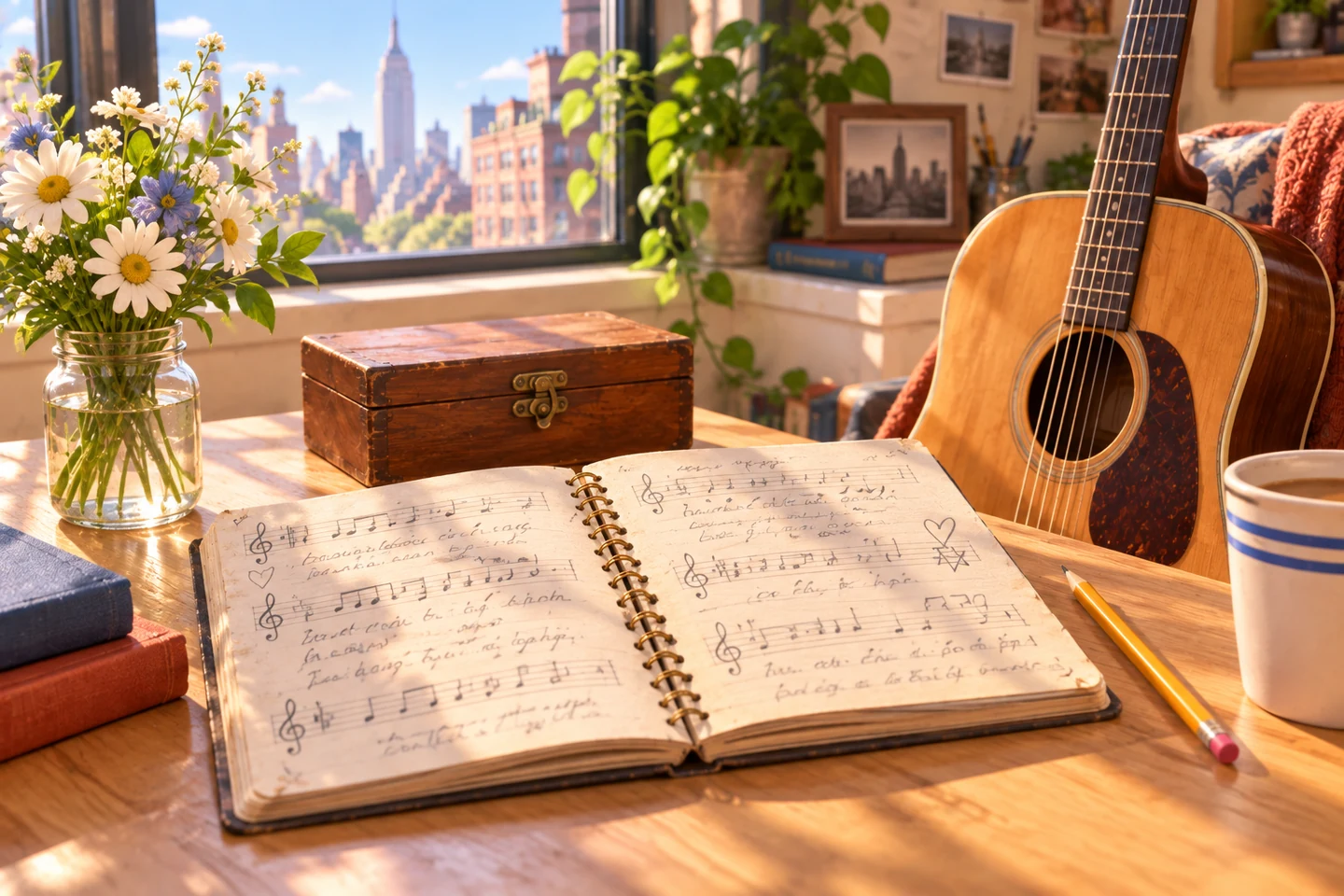
The Long Walk for a Slice
Written by
Walter J. Kin
First Draft
Some crowd dialogue draws on RIGLI listener comments.
These lines are adapted for fictional characters.
FADE IN:
EXT. TIMES SQUARE, GRANITE PARAPET, NIGHT (LATE)
Late, well after dark. Not the billboards. The parapet.
A long granite ledge, and a row of strangers sitting along it shoulder to shoulder the way strangers do at night.
A COUPLE share one set of earbuds, heads tilted in. A NIGHT-SHIFT WORKER in a reflective vest nurses a coffee, a lanyard at her chest. Two TOURISTS puzzle over a paper map by phone light.
Last in the row, a man in a worn good coat. A cloth-bound SONGBOOK rests flat on his knee, one hand laid over the cover.
This is JOSEPH SHAPIRO, around forty. He is not looking at the lights. He is just here.
He is not sad. He is full.
The square roars softly, far away, like surf heard from a bed.
Under it, almost too faint to place, a single Yiddish melody drifts. TUMBALALAIKA. Source unclear. Like memory leaking into the air.
Joseph breathes the night.
His eyes drift, and settle.
A bare patch of pavement, a few steps off. Roped stanchions still half standing. A crew coiling cable in the dark. The skeleton of a stage, being struck.
A WORKER rolls a heavy case across the empty ground. The wheels rumble.
Joseph watches the patch. He does not look away.
He holds there a long moment.
His thumb moves once on the cover of the book, as if keeping a place in something. He breathes. The crew works on. The patch is just pavement now.
Then, gently, he lets it go.
A new smell reaches him on the warm air. Bread, oil, something good.
He half turns toward a glowing slice counter down the block. Its light is a small warm island in all that neon.
He measures the distance. The long bright blocks between here and there.
JOSEPH (V.O.)
(dry, to himself)
A wonderful idea. A terrible walk.
He resettles on the parapet, satisfied, like a man who has just had dessert by thinking about it.
The night-shift worker beside him notices the small private smile. She tips her coffee toward him.
NIGHT-SHIFT WORKER
Some of this pretzel? It is going cold on me.
JOSEPH
You are kind. Not tonight.
She huffs a laugh, settles back. A tiny grace between two strangers.
Joseph rests his hand flat on the songbook. Then opens it a few inches.
INSERT, THE SONGBOOK:
Handwritten staves. Yiddish and Hebrew, soft and faded. On the flyleaf, in ink gone the color of weak tea, a name:
REBECCA SHAPIRO.
BACK TO SCENE.
He does not read it to us. His thumb traces a single line of music.
Under his breath, he hums. The same Tumbalalaika thread. Lo-fi, cracked, a kitchen hum.
The night-shift worker catches it. Her face changes.
NIGHT-SHIFT WORKER
I am not Jewish.
(beat)
But it takes you by the throat.
Joseph turns, surprised. Moved that the tune carried that far down a granite ledge.
A small shared nod. He does not explain himself.
NIGHT-SHIFT WORKER (CONT'D)
You missed it, by the way. There was a thing here. Kids. Couple nights back. Whole crowd.
JOSEPH
(a private smile)
I did not miss it.
The smile is a door.
His gaze drifts back to the empty patch of ground.
The hum slows.
SLOW PUSH IN on his eyes.
SOUND, PRE-LAP: from nowhere on the night air, a distant crowd roar. Applause, swelling.
On the empty patch, the dark seems to gather.
MATCH CUT TO:
EXT. TIMES SQUARE, NIGHT (TWO DAYS EARLIER)
The same ground. Alive.
Where the bare patch was, a temporary stage now stands, exactly there, lit and loud. A banner above it reads STUDENT MUSICAL CHAMPIONSHIP. A sea of faces from everywhere fills the square.
Behind the stage, in the gap between two parked trucks, a knot of young people wait their turn.
THE SHARPIES. A dozen-odd students, late teens, in their own clothes, not costumes. Named after a teacher. They named themselves.
ETHAN MILLER, loud, drums a frantic rhythm on a road case with two fingers.
ETHAN
You know what they do to the team that loses? Nothing. Absolutely nothing. We go home. It is the saddest thing in the world.
Nobody laughs. He drums faster. He is the heartbeat, and the heartbeat is terrified.
Off to the side, CLARA and MARTA MARTINI, identical twins, stand forehead almost to forehead, harmonizing a few soft bars of TANTI AUGURI under their breath. It steadies their hands. It is the only thing that always works.
MARTA
(mid-harmony, to Clara)
Win or lose, we open the cafe before dawn.
CLARA
Before dawn.
MARTA
The world does not care that we are artists.
They go back to harmonizing.
AVIVA, calm at the center, holds the open songbook. She reads a line aloud in the original Yiddish, no hesitation, like water. The ones near her settle toward it.
YUKI TANAKA answers her, gentle, pushing the other way.
YUKI
It should not sound like a museum, Aviva. It happened lifetimes ago. Make it happen now.
AVIVA
And if we make it happen now, we should still know whose it was.
YUKI
We do.
(a grin)
That is why we get to run with it.
It is not a fight. It is the engine. Reverence and forward motion, leaning on each other.
OKSANA crouches over her violin, tuning a string that will not hold. She mutters at it in Ukrainian.
PALOMA snaps a flamenco rhythm against her thigh.
PALOMA
Klezmer and flamenco. Long lost cousins. I keep telling you.
TYRON, eyes closed, catches her snap and turns it, under his breath, into a modern pulse. Boom, tick, boom.
HADLEY presses one flat palm against the cold metal of the truck.
HADLEY
I can feel them. The crowd. Through the steel.
(to herself)
The frequency under the frequency.
SIMON, headset on, thumbs a small lighting board and watches the stage wash bloom and fade.
JOSEPH moves among them. Dry, calm, weightless. He fixes Ethan's collar without comment. He catches Oksana's eye and taps his own ear, and somehow the string holds.
He does not give a speech.
JOSEPH
(quiet, to all of them)
Sing it to one person out there. Just one. The rest will lean in.
He squeezes Aviva's shoulder. He sends them toward the light.
In the wings, MS. ELAINE VANDERBILT, the school director, passes him. She fought this show. Then, under pressure, she allowed it. She does not look at him.
VANDERBILT
I was wrong about the noise.
(beat)
Do not make me regret saying so.
JOSEPH
I would not dream of it, Elaine.
She almost smiles. She does not. She goes.
Out front, half lost in the crowd, BUNNY MONTGOMERY, Park Avenue armor, dabs once at her eye and glares at the sky as if a wind had done it. LEO stands at her elbow, calm and close. Half a step behind, two men in plain jackets watch everything and nothing, the kind of detail only a careful eye would catch. She is never quite alone, even here.
Joseph, alone now for one breath, touches the songbook cover.
INSERT: REBECCA SHAPIRO, in ink.
He closes his eyes.
JOSEPH (CONT'D)
(barely audible)
Mom.
One second. He holds it.
Then he opens his eyes and watches his children walk into the light.
ON STAGE.
It starts small. Human.
Aviva alone, the songbook in her hands, the old melody pure. The SAME Tumbalalaika thread Joseph hummed on the parapet.
Oksana's violin enters, so raw it almost screams. The reverent root of the thing.
It hangs there a moment, just voice and string, and the square goes still to hear it. Aviva does not hurry. She lets the old tune say its first sentence whole, the way her grandmother might have, and the front rows lean toward her without meaning to.
Then Aviva goes quiet, and hands it to Oksana.
Oksana takes the Tumbalalaika alone. The same thread, but in three-four now. A waltz, slow and grave and impossibly sweet.
Her bow is in no hurry. The solo runs long, a full minute, then into a second, and the square discovers it is in no hurry either.
The crowd does not just quiet. It freezes. A thousand people caught mid-step, mid-sentence, hung on the end of her bow.
Out in that stillness, a COUPLE begins to dance. Tourists, unmistakable, cameras slung at their necks, a fanny pack, a lanyard from some museum. They find the three-count and turn, slow and solemn, like people who wandered into something holy by accident.
A SECOND COUPLE catches the idea, giggling, and folds into a clumsy waltz of their own.
They get ten seconds of it. Maybe fifteen.
Then Oksana lands the last note clean, and the melody is simply done.
The second couple is left mid-turn, swaying toward a beat that never comes, caught dancing to a song that already ended. They stop, sheepish and delighted.
A ripple of warm laughter moves through the square. The spell does not break. It opens.
And Aviva lifts the melody back into her own voice.
Then the turn.
Tyron drops a pulse under it, modern, low. The square feels it before it hears it. Yuki lifts the tempo a breath, and the old melody shrugs off a century and stands up straight.
Paloma's flamenco snap answers the klezmer and they are, for a second, the same animal. Oksana hears it and grins mid-bow and leans into the swing.
Hadley's cello becomes the floor everyone stands on.
And Simon answers each sound with light. A palm on a string, and a wall of the square goes amber. A snap, and the color jumps. He is playing the room.
The crowd, faces from everywhere, leans in. Exactly as Joseph promised.
IN THE WINGS, Joseph watches. His lips move with the words.
He does not sing out. He guards. He is undone.
IN THE CROWD, the camera simply passes a WOMAN, tears bright on her cheeks. She leans to her neighbor.
WOMAN
I am Russian. And I cannot hold back the tears.
The camera drifts on. A MAN, arms folded, jaw working.
MAN
I am Tatar. But I have loved these songs since I was small.
No speech. Just faces. The camera moves on, past a girl mouthing words she cannot know but somehow knows, past an old man with his eyes shut.
The melody peaks, and the troupe lets it breathe, and holds.
A held breath across the whole square.
LATER, ON STAGE.
The summit.
Aviva, alone again at the lip of the stage. Quiet. She begins WE ARE SISTERS WE ARE BROTHERS, the old kinship song made new.
Just her voice.
Then the twins, Clara and Marta, fold their harmony under hers.
Then Yuki. Then Ethan's voice, low and careful, the cynic singing like he means it. Then all of them, the whole troupe, and the chorus opens.
And then.
A few voices in the crowd pick it up. The tourists with the paper map. A girl on the rail. A waiter who stopped to listen.
Then a whole block of them.
Then the square is singing the chorus back.
The song escapes the stage.
For one beat, the sound drops out. The camera finds Joseph in the wing, and the world goes nearly silent on his face, his mouth shaping the words, his eyes spilling over. We hear the song the way he hears it, from far inside.
Then the sound floods back, warmer than before.
It is not only theirs now. It is not only Jewish. It is the night-shift worker and the tourists and a CHILD on someone's shoulders and the Tatar man and the Russian woman, one sound.
Oksana's violin, Paloma's flamenco, Tyron's beat, Ethan's heartbeat drum, all fuse. Simon lifts the light. Hadley's low note is felt in the chest of every stranger the camera finds.
IN THE WING, Joseph does not move to the center. He made himself unnecessary, and it is the most beautiful thing he has ever felt.
He lets go. He weeps, openly, the songbook pressed flat against his heart, and lets the children carry it without him.
The chorus rises and breaks like a wave.
LATER.
A PRESENTER on stage. The square holds its breath.
The presenter simply lifts a hand toward THE SHARPIES.
The crowd ERUPTS.
That is all. No tally on a screen. Just a hand, and a roar.
The Sharpies have won.
It hits them in the body. Many of them dissolve at once.
Aviva covers her mouth with both hands.
Oksana lowers the violin and shakes, helpless.
And Ethan, the loud cynic, the one who armored every feeling in a joke, comes apart completely. He hides his face in a road towel.
Marta pats his back, laughing and crying at the same time.
MARTA
There he goes. There he finally goes.
And then, in the middle of the joy, MARTA herself goes pale. Her eyes lose focus. Her knees give, and she folds.
A caught breath.
Hands catch her at once. Many hands. Clara is already there, on her knees, palm to her sister's cheek.
CLARA
Marta. Marta, hey.
A beat.
Marta's eyes flutter. She comes back, dazed, blinking up at a ring of frightened faces. Then she laughs.
MARTA
(woozy, grinning)
I am fine. I am fine. Put me down, I am embarrassed.
She is not even all the way down. They laugh, wrecked with relief. No ambulance. No danger. Thank God.
ETHAN
(wiping his face, hoarse)
She fainted from joy. And right on time. We could not have planned it.
CLARA
(helping her up)
You will hear about this every day. Forever.
MARTA
Worth it.
Joseph reaches them and is swallowed by all of them at once. He hugs each one. He says the right small thing in each ear. He holds Marta's face in both hands and checks her eyes himself, then kisses the top of her head.
He steps back, half in, half out of the knot of them. He looks up, past the lights, the songbook against his chest.
JOSEPH
(simple, to no one, to her)
Mom would have heard this.
The triumph crests. And for Joseph, inside all that noise, it goes quiet.
He goes still in the middle of the celebration. The songbook held to his chest. He looks up and out, past the stage, the way a person looks for someone who is not there.
He turns his head, slowly, toward one exact spot at the edge of the square.
The roar begins to thin in the sound. The light narrows to his wet, smiling face.
DISSOLVE TO:
EXT. TIMES SQUARE, GRANITE PARAPET, NIGHT (BACK TO PRESENT)
The same face, now in streetlight. Same head. Same eyeline.
The crowd roar has become traffic hum.
Joseph sits on the parapet. His eyes are exactly where they were, on the bare patch of ground.
The crew has nearly finished striking the stage. The last stanchion comes down. The patch goes back to being ordinary pavement.
He understands, without a word, that he has just watched a memory stand up and sit back down on the very same spot.
The Tumbalalaika hum fades back into the city.
The row of strangers has changed. The night-shift worker is gone. A different person sits in her place. The couple stands to leave, and one of them gives Joseph an absent goodnight nod, recognizing nothing.
JOSEPH
Goodnight.
He is alone in a full square.
He opens the songbook a few inches again.
INSERT: REBECCA SHAPIRO, faded ink.
He does not read it. He rests his hand inside the book, flat on the songs.
Near him, a YOUNG STRANGER, a backpack, a tourist by the look, notices the old cloth-bound book. The handwriting. The age of it.
YOUNG STRANGER
That looks really old. What is it?
Joseph considers the long answer. The whole life of it.
He gives the short one.
JOSEPH
Songs my mother kept.
YOUNG STRANGER
Did she write them?
JOSEPH
Some. Mostly she kept them safe.
The stranger looks at the book a moment longer.
YOUNG STRANGER
That is beautiful.
JOSEPH
(a small smile)
It is, isn't it.
The exchange is tiny. It is the whole point. The songs reaching one more stranger, here, now, off any stage.
The young stranger shoulders the backpack, lifts a hand, moves on into the current.
Joseph's eyes flick, once, toward the distant glow of the slice counter. Still there. He still has not gone.
He shakes his head at himself, fond.
The Tumbalalaika hum returns, softer now, carrying the full weight of the last two days.
He closes the songbook. His hand on the cover.
JOSEPH (CONT'D)
(a breath, no more)
Mom.
The square's noise drops away under the melody.
SOUND, PRE-LAP, on the very edge of hearing: a woman's voice. Warm. Lo-fi, like a kitchen recording. The same melody beneath it.
Joseph closes his eyes. Not to flash back to the stage. Inward.
MOTHER (V.O.)
(the remembered dream, warm, faraway)
Guard these songs.
Push in on his still face.
MOTHER (V.O.)
They are not only ours. Not only Jewish.
A soft flash, behind his eyes: the chorus converging. The crowd singing it back. A child on shoulders. Aviva's hands over her mouth. The quick happy faint, and the laughter after it.
Nothing else. Only that.
MOTHER (V.O.)
They are songs about all people. About how we are one family. Children of the Lord.
The line settles over him like a coat laid on a sleeping man.
Joseph's eyes open.
He looks out at the square. The whole moving river of it. Night-shift workers and tourists and lovers and the ones who recognize nothing.
A long breath, let go. His eyes are wet, and he laughs at himself, one small huff, a man who took a whole lifetime to hear a sentence he already knew by heart.
He is still lonely. Still devoted. But no longer only a guardian.
JOSEPH
(soft, to the night, to her)
Mom.
A thank-you and a goodnight in one syllable.
He sits with it.
Then his stomach, gently, has an opinion.
He looks, one more time, down the long bright blocks to the slice counter.
JOSEPH (CONT'D)
(to himself)
All right. All right.
He stands. He tucks the songbook under his arm, one hand resting on the cover.
And he starts to walk. Toward the distant light. The long walk, at last.
A small man, choosing pizza and the long way to it. No longer staying put.
He hums as he goes. The warm melody, under his breath.
A few bars of it lift up off him, into the air, and hand off to the living sound of the city, car horns and laughter and a thousand footsteps.
The tune is no longer only his.
He becomes one more figure in the crowd. One among all peoples, moving through the bright square.
FADE OUT.
Written by Walter J. Kin.
THE END.