At a private Manhattan arts school, a teacher brings his late mother’s songbook to class. The students want to give its songs new English voices. What begins as a memorial concert grows into the stage show they create together, Jewish The Musical. JEWISH is the feature movie musical about that journey.
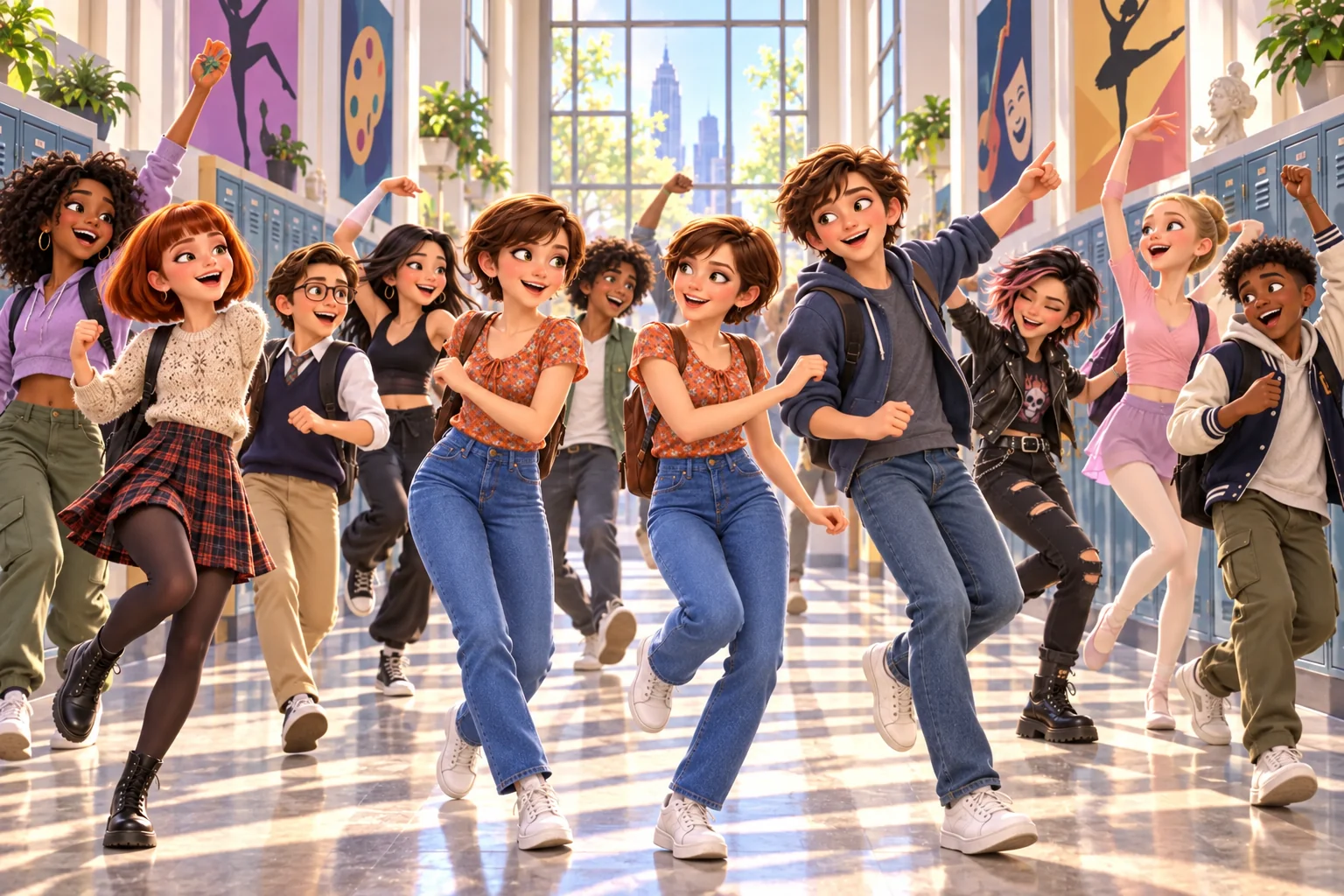
At MASA, a costly private arts school on Manhattan’s West 48th Street, light fills the corridor. Beautiful, expensive lockers line both walls. Students sing “Broadway” as they move between classes; more voices join, and the hallway becomes a dance.
Their number opens the film. Joseph’s songbook and the students’ show come later. The screenplay is still being revised by Walter J. Kin.
The story continues · Times Square
A voice reaches the city
Later that night, Joseph Shapiro sits on a low parapet in Times Square, listening to his mother Rebecca’s Russian song on his phone. A childhood memory gives way to Tumbalalaika. Joseph slips from the parapet; his phone clatters free, and the disconnected earbuds let Rebecca’s voice reach the square. Felicia, a night-shift worker, and a few passersby stay to hear the phrase finish.
Act I · The Walkout
The songbook becomes a choice
After Rebecca’s recent death, Joseph dreams that she asks him to carry her songs forward. He brings her songbook to MASA and proposes a year-end concert in her memory. The students want English versions they can mean and sing; Joseph insists on the original languages, and the class walks out. The Martini twins return with another possibility: English adaptations the students can sing in their own voices.
Act II · The Show Takes Shape
A concert becomes Jewish The Musical
At OyPizza and school, the students work through translation, arrangement and disagreement. After their music begins reaching listeners, Hadley asks whether the concert could tell a story. The class proposes a forty-five-minute school show called Jewish The Musical.
The work fractures when Joseph stops Yuki’s Freedom Tango at an OyPizza dress rehearsal in front of onlookers. She leaves; Aviva defends the version they have revised together. Joseph eventually tells Yuki he should have heard her all the way through. She returns to rehearsal without pretending they agree, and the class begins working together again.
Act III · The School Show and Final
From the auditorium to Times Square
The students perform their show in the MASA auditorium. It makes them eligible for a national competition; qualifying rounds lead to a live final in Times Square.
At the final, Yuki sings Freedom Tango without Joseph’s approval. He starts toward the stage, then chooses to sit and hear the whole song. Backstage, she admits she should have told him; he acknowledges that her performance let him hear what he had refused at rehearsal.
History and fiction
Rebecca’s Inheritance & The Yellow Star
Behind the music lies a family torn apart by war. Rebecca’s mother, Sonya, came from Odessa; her father, an Austrian engineer, worked in Moscow and Berlin. In 1939, six-year-old Rebecca was sent to safety in the Netherlands, where the Olsen family hid her Jewish identity under occupation.
In the Netherlands, Jews were forced to wear yellow stars from May 1942; some non-Jewish Dutch people protested with homemade stars. Read the historical context from the Anne Frank House. Rebecca and the Olsens are fictional characters. In the screenplay, Jan joins about a hundred neighbors for a solidarity march that police block. His wife sews Jan’s star beneath the lining of a music box before he gives it to Rebecca, telling her: “Don’t lose this box. It holds the memory of you, of your family.”
Decades later in Brooklyn, Rebecca sang these songs at senior centers and community halls. Through The Sharpies, that fragile inheritance breaks out of mourning and into the world.
Continue into the project
Explore the ensemble and music, or read The Long Walk for a Slice, the first draft of the proposed proof-of-concept short.